
Federal Prison Scope Near Eureka
No official source reviewed established a Bureau of Prisons institution in Eureka County. The federal system page is therefore a contingency route for a person charged or sentenced federally, not the default way to check an Eureka arrest. A local detainee may begin with the Eureka County Sheriff, spend time in White Pine or Lander County, enter U.S. Marshals custody during a federal case, and reach a BOP institution only after a federal sentence.
Each step creates a different record. ECSO and the housing jail document the local movement. The federal court docket explains the prosecution, detention orders, judgment, and sentence. The U.S. Marshals Service manages many pretrial movements. BOP maintains federal prison custody and its own release information. A county “release” code naming a federal agency signals transfer, not return to the community.
Search the BOP Inmate Locator
The official BOP Inmate Locator covers federal prisoners from 1982 forward. Search by a federal identifier when one is known. Accepted identifier routes include the BOP Register Number, DCDC number, FBI number, and INS number. The alternative uses a name with demographic filters. An identifier usually produces a more precise match than a name alone.
- Choose the number search when a reliable federal identifier is available.
- Otherwise enter the full name and use age, race, and sex fields to narrow likely matches.
- Compare the displayed name, register number, age, race, and sex before relying on a result.
- Read the release date and location exactly as shown.
- Save the register number for a court or records inquiry.
- Compare the locator result with the federal judgment and later docket entries.
The BOP locator screenshot below comes from the official federal search page and shows the search routes available to the public.
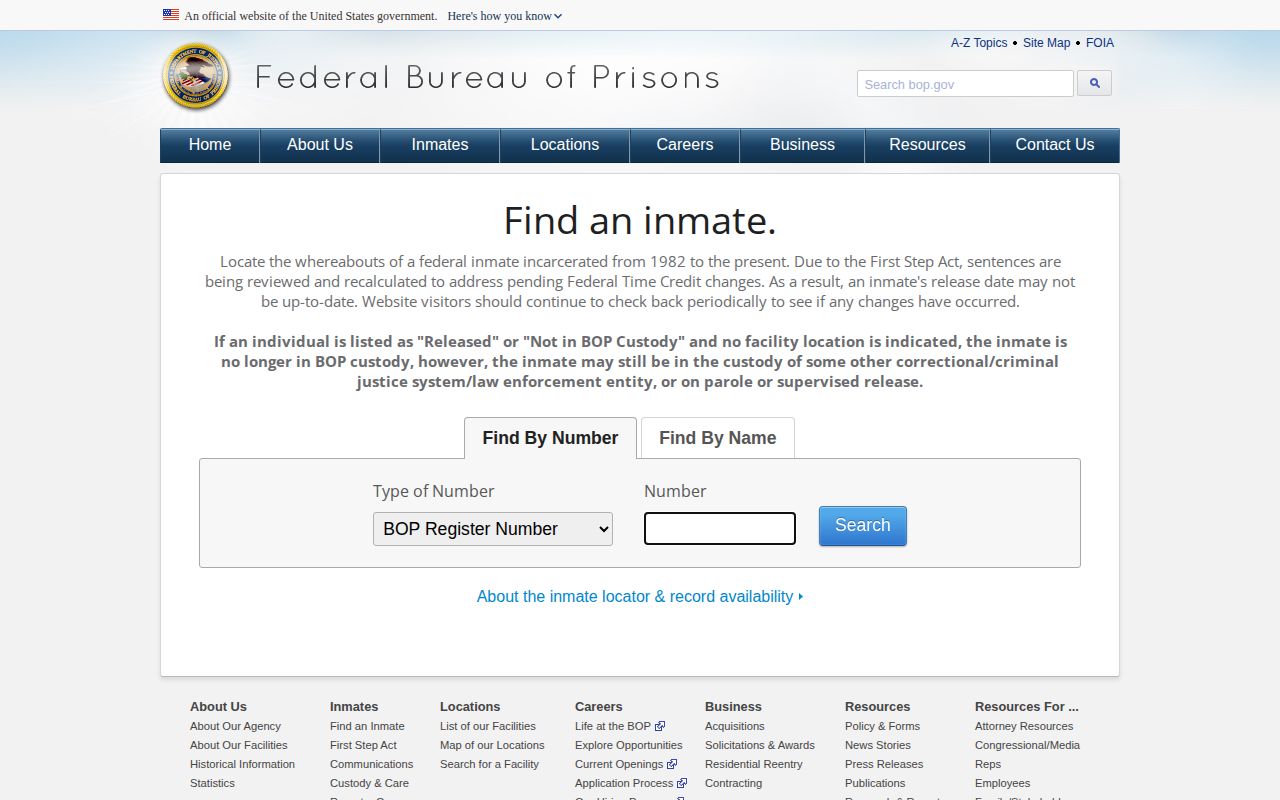
The page is a federal-prison discovery tool. It does not replace the custody or release record created by another agency.
Read Federal Release Results Carefully
A BOP result may display a release date, a location, “Released,” or “Not in BOP Custody.” Those phrases answer a limited BOP question. They do not establish that the person returned to the community, completed every sentence, or left all government custody. The person could be under federal supervised release, held by another authority, or outside BOP custody for another reason.
| Locator item | Safe meaning |
|---|---|
| Release date | The federal date displayed by BOP, subject to later recalculation. |
| Released | BOP reports a past exit from its custody. |
| Not in BOP Custody | BOP does not currently hold the person; another status may still apply. |
| Facility location | The BOP institution shown for the federal record, not an Eureka jail. |
| No result | May reflect scope, identifier, spelling, data, or date limitations and is not universal release proof. |
Federal supervised release is court-ordered monitoring after prison and differs from Nevada parole. The federal docket and supervising federal office, when applicable, explain that status. Do not substitute the Nevada Post-Release Supervision process for a federal case.
Federal Sentence Dates Can Change
BOP warns that sentence computations can be recalculated. Court amendments, jail credit, earned-time application, disciplinary decisions, consecutive terms, or corrected data can affect a displayed date. A locator date should be reported as the federal date currently shown, not as an unchangeable promise of exit.
The judgment supplies the sentence imposed by the court. It may not show every later administrative calculation. The docket may also contain amended judgments, sentence-reduction orders, or other entries that explain a change. BOP records address the agency’s computation and actual prison event. When sources differ, compare the register number, federal case number, judgment date, sentence terms, and the date each source was updated.
Do not apply Nevada’s county-jail rules or NDOC’s PED, MPR, PEXD, and credit fields to a BOP sentence. Those are separate systems. The Release Date Lookup concerns Nevada custody and should not be used to hand-calculate a federal exit.
Confirm a Federal Prison Exit
The strongest available confirmation pairs agency and court records. Begin with the BOP locator to identify the register number and reported date. Then find the federal criminal docket and judgment. Review later orders around the release window and determine whether custody shifted to another authority. A federal release order establishes legal authority, while the relevant custodian’s record establishes the event it processed.
If the person first left Eureka custody, obtain the county or contract-jail movement entry. Ask for the release or transfer date and time, release code with its definition, and destination or receiving agency. A destination naming USMS or another federal authority proves only that the county jail ended its part. It does not show community release.
For durable proof, request the specific BOP or federal record rather than relying only on a screenshot. Include the full name, register number, federal case number, date range, and exact document or event sought. If the requested office lacks the record, ask which agency created or holds it.
Use the Federal Court Docket
A federal docket can supply detention orders, release conditions, plea and sentencing entries, the judgment, later sentence changes, and supervised-release proceedings. Search the correct federal district and case. A name-only result can match another person, so verify the case number, charge dates, counsel, and identifiers available in public documents.
The docket answers the legal side of custody. It may show that a judge ordered detention, approved release conditions, imposed a BOP sentence, modified the sentence, or addressed supervised release. It does not necessarily record the exact minute an institution completed processing. Pair it with BOP or housing-facility information.
For an Eureka-linked federal matter, the District of Nevada U.S. Marshals courthouse locations provide a routing point for custody questions. The Marshals Service may direct an inquiry to the actual contracted or government facility holding the person.
Separate BOP, USMS, and ICE
BOP generally concerns sentenced federal prisoners. USMS often manages federal pretrial detainees and sentenced prisoners awaiting designation or movement. ICE administers civil immigration detention. One person can move between these systems, but none of their public tools has universal coverage.
The U.S. Marshals Service detention network has no public historical locator comparable to BOP. The ICE detention system locator is aimed at present ICE custody and does not provide a historical release archive. A BOP no-result should not be converted into an ICE or USMS conclusion. Follow the last documented receiving agency.
Likewise, a Nevada S.A.V.E. notification is not a federal prison record. S.A.V.E. replaced Nevada VINE for participating Nevada agencies and can provide a useful alert, but its notice cannot prove BOP release.
Eureka Records Before Federal Transfer
Eureka County has no public 24-hour or 72-hour release feed. Call ECSO at 775-237-5330 to identify the actual housing jail, then request the custody movement or release entry. Official 2025 county records show use of White Pine and Lander County jails, so the agency that held the person may own the physical handoff record.
Ask ECSO Records for the booking sheet, movement log, date and time, code definition, and destination. Submit the official form to ECSOrecords@eurekacountynv.gov, P.O. Box 736, Eureka, NV 89316, or 411 North Main Street. If White Pine or Lander processed the event, direct a focused request there. The Eureka record proves the local movement. BOP and federal court sources must prove the later federal stage.
When the BOP Search Fails
Recheck name spelling, aliases, demographic details, and every known federal identifier. Confirm that the event falls within the locator’s coverage from 1982 forward. Determine whether the person was merely in USMS pretrial custody and never entered BOP, or whether another agency received the person. Then use the federal docket and the actual housing facility.
A missing result is not evidence of a clean or complete history. It can mean the wrong system, a mismatch, a custody stage outside BOP, or a record limitation. Convert telephone routing into a written request when confirmation must be preserved.