
Eureka County Date Sources
Start with custody type. The Eureka County Sheriff does not publish an online jail roster or release-date field. Official county records also show that local detainees have been housed in White Pine and Lander County jails. Call ECSO at 775-237-5330 to identify the actual housing jail for the person and date in question. Ask that jail for its sentence calculation, any presentence credit it applied, and the release entry. A court order may authorize release, but the jail log establishes when processing occurred.
A person sentenced to Nevada state prison belongs in the NDOC offender search. Search by first and last name, offender ID, or offender-book ID as the form permits. The profile can show sentence milestones, custody status, and “PAROLE.” The downloadable Release data ties an offender ID and book ID to a release date and description. Cross-check the book ID against Booking and Parole data so one sentence episode is not confused with another.
- Identify county jail, Nevada prison, federal, ICE, or U.S. Marshals custody.
- For a county case, obtain the sentencing or release order and ask ECSO which jail made the calculation.
- For a prison case, search NDOC and record the offender ID, book ID, status, and each labeled date.
- Check Nevada Parole Board records when parole eligibility or an action affects the timeline.
- Confirm the actual exit in the custodian’s release record.
Eureka County Prison Milestones
Nevada prison records use several dates. PED is the parole eligibility date, the point at which release on parole may become legally possible. It is not a promise that parole will be granted. MPR is mandatory parole release, a distinct milestone that generally applies to qualifying terms and has exceptions. PEXD is projected expiration after credits. RRD is a residential-confinement-related date. The raw profile may also show a minimum and maximum sentence.
| Field | Meaning | What it does not prove |
|---|---|---|
| PED | Parole eligibility milestone | A grant or physical release |
| MPR | Potential mandatory-parole milestone for a qualifying term | Eligibility when an exception, hold, or consecutive sentence applies |
| PEXD | Projected credit-reduced expiration | The final exit date after later credit or case changes |
| RRD | Residential confinement milestone | Unconditional community discharge |
| Release entry | A reported custody event tied to an offender and book ID | The end of all supervision or other custody |
The Nevada Board explains that MPR is often five or six months before PEXD even though the statute describes a point twelve months before the credit-reduced maximum. Credits continue to affect the maximum, and a consecutive term can prevent the calculation. Read the displayed label. Do not convert one field into another.
The official NDOC search form is shown below. Its fields help distinguish one Eureka County release-date record from a similar name.
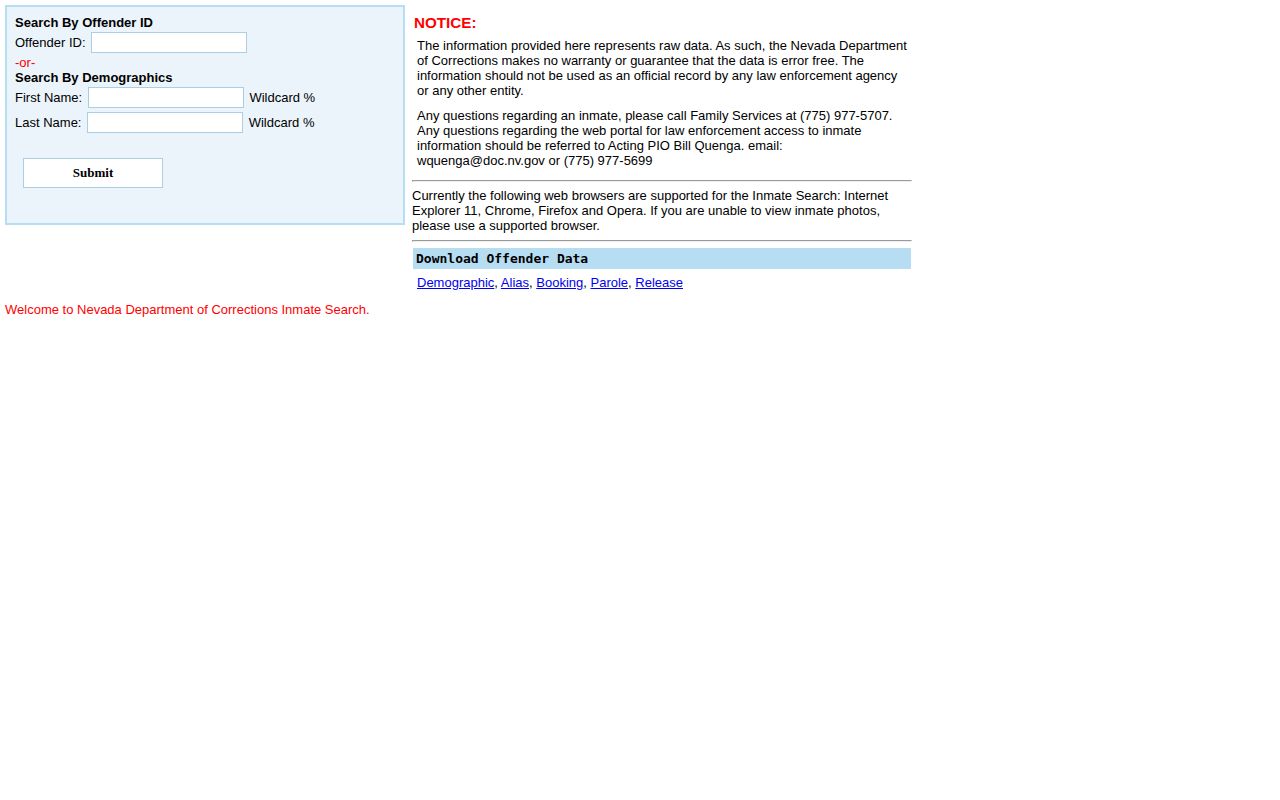
The public portal is discovery data, not a guaranteed official record. For proof, request the specified event from NDOC Offender Management Division.
No Eureka County 85% Rule
Nevada does not have a general rule that every prisoner serves 85 percent. An official legislative report explains that Nevada considered that model but adopted minimum-and-maximum truth in sentencing. Under NRS 193.130, the minimum generally may not exceed 40 percent of the maximum outside Category A crimes or a different governing statute. Offense-specific minimums and credit exclusions still control.
For crimes committed on or after July 17, 1997, NRS 209.4465 provides several credit categories. Qualifying conduct can earn statutory credit, while work, study, education, outside programs, and exceptional service can support other credits. The statute does not apply each credit to every minimum term. It excludes listed offense groups from minimum-term application and caps qualifying minimum reductions for relevant offense dates.
The official statute page already displays a different 35-percent framework in NRS 209.4467 that takes effect July 1, 2027. That is future law on the research date. It must not be used as the current 2026 rule. Any calculation after its effective date needs a fresh review of the law then in force.
Eureka County Date Changes
A projected release date moves because it depends on law, sentence structure, credits, agency records, and later events. Presentence confinement credit under NRS 176.055 may affect the sentence. Earned programs can add credit. Misconduct can result in forfeiture. Aggregated consecutive terms under NRS 213.1212 create a different timeline than one isolated sentence. A corrected offender or booking record can also change the public display.
| Change | Possible effect |
|---|---|
| Credit earned or restored | May reduce an eligible maximum or affect an eligible minimum. |
| Credit forfeited | May move a projected milestone later. |
| Consecutive sentence | May require further custody after one term reaches a milestone. |
| Parole decision | A grant permits conditional release only after lawful processing and any holds. |
| Detainer or warrant | May cause transfer to another authority instead of community release. |
| Data correction | Can change the portal without reflecting a new court event. |
Eureka County Jail Calculations
No official public source was found for a Eureka County jail good-time rule, weekend-release rule, or standard calculation method. Do not apply NDOC prison credits to a county-jail sentence. Obtain the sentencing order, presentence-confinement credit, and the housing jail’s calculation. White Pine or Lander may have processed the term under the applicable judgment and the operating arrangement with Eureka County.
Pretrial custody is different. A person who has not been sentenced may have a bail hearing, own-recognizance order, dismissal, or other court event, but no fixed sentence expiration. Eureka Justice Court handles misdemeanor cases and preliminary or pretrial matters. Felony and gross-misdemeanor disposition after bind-over belongs to the Seventh Judicial District Court clerk. A court time and jail exit time can differ because they mark authorization and processing.
Ask for the docket and actual order. Then ask the jail for the release date and time, release description or code, and destination or receiving agency. A transfer to NDOC, another jail, ICE, or the U.S. Marshals Service is a release from one ledger, not a release to the community.
The records should be reconciled rather than forced into one timestamp. A judge may sign an order before staff receive it. Staff may need to verify identity, check a warrant or detainer, close the booking record, and arrange a transfer. No official Eureka source publishes a standard release hour, weekend practice, exit door, or processing interval. Call the actual housing jail for those facts. Do not infer them from a neighboring jail directory or from the date printed on a court docket.
Eureka County Parole Timing
The Nevada Board of Parole Commissioners posts monthly eligibility lists, hearing schedules, and actions. Appearance on an eligibility list is not a grant. A hearing result may be delayed until the required agreement and notification process is complete. Even a grant remains subject to lawful eligibility, release planning, holds, and prison processing. Compare the Board action with NDOC’s later release entry.
“PAROLE” on an NDOC profile means supervised release. It is not sentence discharge. Nevada State Police’s Division of Parole and Probation can confirm active supervision, while a discharge document under NRS 213.154 is stronger proof that parole ended. The broader verification path appears on Eureka County Post-Release Supervision.
- Parole
- Conditional release from prison while the sentence remains under supervision.
- Probation
- A court-ordered community sentence that may exist without an NDOC prison record.
- Detainer
- A request or legal basis for another authority to take custody.
- Discharge
- The formal end of the relevant custody or supervision status.
Eureka County Official Proof
NDOC warns that its portal contains raw data and is not guaranteed error-free. For an official state-prison record, email omdrecords@doc.nv.gov or write Offender Management Division, Nevada Department of Corrections, P.O. Box 7011, Carson City, NV 89702. State the offender ID, offender-book ID, date field or release event sought, and whether certification is needed. Family Services is listed at 775-977-5707 for inmate questions.
For a county-jail date, use ECSO to locate the custodian and submit a focused request to the housing jail. For federal custody, the BOP locator can show a release date but warns that sentence recalculation can change it. ICE’s locator concerns current immigration custody, and the U.S. Marshals Service does not publish a historic release tool comparable to BOP. Choose the record system before trusting the date.
A future date can be tracked through a notification, but the Eureka County VINE Inmate Check now uses Nevada S.A.V.E., not VINELink. An alert is still a lead. The custodian’s record remains the proof.
Nevada public-record law supplies the request framework. NRS 239.010 begins with access to nonconfidential government records. NRS 239.0107 requires the agency to respond by the end of the fifth business day by producing the record, denying it with legal authority, stating that it lacks custody, or giving a written availability estimate. NRS 239.052 generally limits copy charges to actual cost unless another law controls. Sealed court records, juvenile material, privacy interests, and active-investigation limits can change what is released.
Request one date and sentence episode at a time. Include the person’s full name, case or offender number, booking identifier, and the exact labeled field in dispute. Ask the office to define any abbreviation rather than guessing. A certified order proves what the court directed. A certified release or custody record proves the event the agency processed. A parole action proves the Board’s decision, while the later NDOC entry is the stronger evidence of physical release from state custody.