
Eureka County Parole Versus Probation
Parole and probation can both involve rules in the community, but they begin in different ways. Parole follows release from a Nevada prison sentence. The Nevada Board of Parole Commissioners makes parole decisions, while the Nevada State Police Division of Parole and Probation, known as NPP, carries out field supervision. Probation usually follows a court judgment and may be imposed without a state-prison stay. The sentencing court is therefore the best first record for an ordinary probation case.
| Status | What it means | Best first source |
|---|---|---|
| Parole | Conditional release from prison while the sentence remains under supervision. | NDOC profile and release data, Parole Board action, then NPP. |
| Probation | A court-ordered sentence supervised in the community, often without prison. | Justice or District Court judgment, then NPP. |
| Discharge | Formal completion or termination of supervision. | NPP discharge document and the relevant court record. |
A county jail release does not itself end probation. Likewise, an NDOC profile that says “PAROLE” describes supervised release, not full discharge. A release record should be read beside the judgment, Board action, and current NPP information. That chain prevents a past label from being mistaken for a present status.
Check Eureka County Supervision Status
There is no verified public statewide NPP name search. The sound route depends on the sentence. Use an NDOC Offender ID when one exists because names can be shared or misspelled. NDOC generally covers people sentenced to Nevada state prison, not a person who served only county-jail time or an ordinary probationer who never entered NDOC.
- Identify the court case, full name, date of birth when legitimately known, and any NDOC Offender ID.
- For a prison case, open the NDOC Inmate Search. Review the institution or status field, sentence dates, booking episode, and Release data.
- Check the Nevada Parole Board monthly actions for the actual decision. A grant is not proof that the person physically left prison.
- Pair the Board action with the NDOC release entry or an official record from the Offender Management Division.
- For probation, request the judgment and any later discharge or revocation entry from the sentencing court.
- Contact NPP with the person’s identifiers and ask which office and agent hold the case. Do not select an office based only on distance.
NDOC raw data carry an express accuracy warning. When documentary confirmation matters, email omdrecords@doc.nv.gov or write the Offender Management Division, Nevada Department of Corrections, P.O. Box 7011, Carson City, NV 89702. State the offender and book identifiers, the release event, and the record needed. The Release Date Lookup explains how Nevada’s public sentence fields differ from an actual release entry.
Which Office Supervises Eureka Releases?
NPP’s Northern Supervision Offices page lists both Elko and Ely, but it does not publish a county assignment map that places Eureka with either location. Elko is at 3920 Idaho Street, Elko, Nevada 89801, telephone 775-753-1305. Ely is at 1539 Avenue F, Suite 2, Ely, Nevada 89301, telephone 775-289-1636. Call with the offender ID and ask which office or agent owns the case.
The office question is not a minor detail. A person may have been arrested in Eureka, housed in White Pine or Lander County, sentenced through one of Eureka’s courts, and later supervised from an NPP office whose assignment is not shown by the public directory. Movement among custody sites does not set the supervision office. Direct confirmation from NPP is stronger than a guess based on the closest city.
The screenshot below comes from the official NPP Northern Supervision Offices page and shows the public office-routing source.
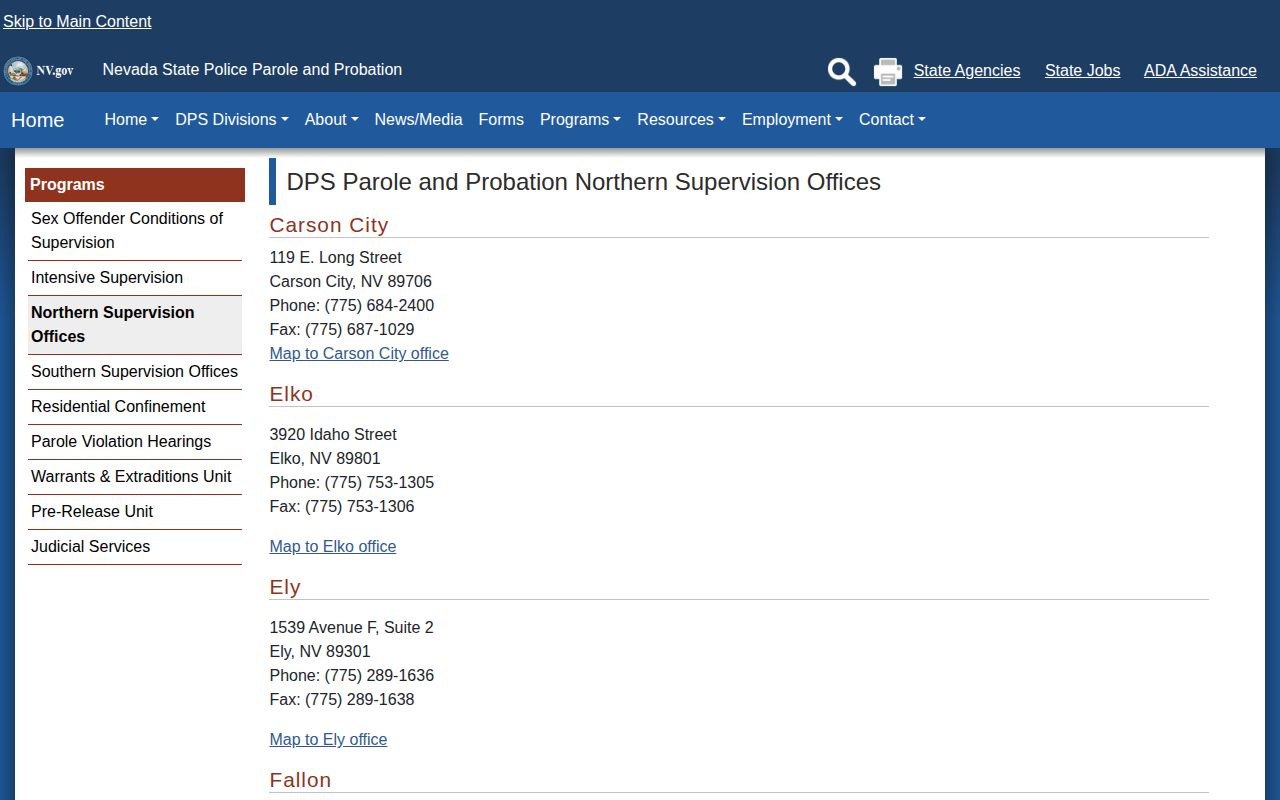
Because that page lists offices but does not assign Eureka County, use it for contact details and let NPP identify the correct case office.
Eureka Probation Court Records
For probation, begin with the court that entered the judgment. Eureka Justice Court handles misdemeanor disposition and preliminary or pretrial matters. Its Eureka Department can be reached at 775-237-5540 or EuJCInfo@eurekacountynv.gov. It also has a Beowawe department with a limited published schedule. Ask for the docket, judgment, probation terms that are public, and any later completion, discharge, or revocation entry.
Felony and gross-misdemeanor matters after bind-over belong with the Seventh Judicial District Court record maintained by the Eureka Clerk-Recorder. The clerk is at 10 South Main Street, P.O. Box 540, Eureka, Nevada 89316, and can be reached at 775-237-5263. A court judgment establishes what was ordered. NPP confirms how field supervision is currently administered. If the record has been sealed under Nevada law, public access may lawfully be limited.
Eureka Supervision Violations and Warrants
An absconder is a supervised person whom the agency alleges has stopped reporting or cannot be located. It is not a label that should be inferred from a missing web result. NPP says an absconder case moves to its Warrants and Extraditions Unit, which works with law-enforcement warrant systems. Those systems are not public name-search databases.
The unit lists 775-684-2644 and nppmostwanted@dps.state.nv.us. Absence from an online flyer does not clear a warrant, and an old post does not prove a warrant remains active. Ask NPP or the court for present status. A violation proceeding may lead to continued or reinstated parole, revocation, deferral, removal, or another result. Use the wording in the current Board action rather than reducing every event to “returned to jail.”
Nevada S.A.V.E. can provide offender-based notifications through save.nv.gov, telephone, email, or text. It replaced Nevada VINE in August 2025. An alert is a lead, not a supervision record, and the portal may omit someone no longer in custody. The VINE Inmate Check page explains the current S.A.V.E. path and the retired VINELink process.
Eureka Parole Decisions and Release
The Parole Board posts monthly hearing schedules, eligibility lists, and action reports. Eligibility means the case may be considered. It is not a release grant. A grant is also conditional on lawful eligibility, release planning, holds, and processing. A consecutive sentence or detainer, meaning a hold requested by another authority, can send the person to another custody instead of the community.
Monthly actions may show a grant, denial, deferral, revocation, reinstatement, removal, or no action depending on the proceeding. Board material says results generally are not announced until four members agree and the institution, facility, and person are notified. Confirm physical exit in NDOC Release data or an official OMD record, then ask NPP about active supervision.
Proving Eureka Supervision Has Ended
Sentence expiration and supervision discharge are not proved by an old profile alone. NRS 213.154 directs NPP to issue an honorable or dishonorable discharge from parole at the end of the applicable term. NRS 213.1543 addresses early-discharge recommendations. The discharge document or direct NPP confirmation is stronger than a historic NDOC “PAROLE” label.
For probation, seek the court’s completion or discharge entry and confirm status with NPP. If records conflict, compare identifiers, sentence episodes, and dates. Ask the agency that created each entry to explain it. A jail exit record proves the physical custody event, while the court and NPP records explain whether supervision continued afterward.
Eureka Supervision Record Access
Nevada’s Public Records Act starts from access to nonconfidential government records, but the location and legal status of a record still matter. NRS 239.010 states the general access rule. NRS 239.0107 gives a custodian until the end of the fifth business day to produce the public record, deny access with legal authority, state that the office lacks it, or provide a written estimate when production needs more time. That framework is not a guarantee that every supervision detail is public or that final production always takes five days.
Ask each office only for the record it creates. The Parole Board owns its hearing and action material. NDOC owns prison booking, sentence, and release entries. NPP owns field-supervision and parole-discharge records. Eureka’s courts own judgments, probation orders, and later court entries. A narrow request with the person’s identifiers, case number, date range, and named document is easier to route than a request for every record about a person.
Sealed court records, juvenile material, private case-management data, and other protected information may not be available through an ordinary public request. If an office withholds a record, ask for the legal basis and whether a public portion can be separated. Do not interpret lawful non-disclosure as proof that supervision never existed. Conversely, a historic public entry should not be treated as proof that supervision remains active today.
Record the date, office, and identifier used for each check. That small audit trail makes later updates easier and shows which agency supplied each part of the status.
Public Record Search
Sponsored Results