
Eureka County S.A.V.E. Check
Nevada S.A.V.E. is the current route for a person-specific custody check and release notification. The Nevada Attorney General operates the system, and the Nevada Department of Corrections directs users to it. Open the Nevada S.A.V.E. portal, create an account or follow the available offender-search prompts, and use the identifying details requested by the live interface. Compare each result closely. Eureka County detainees may be held by the Eureka County Sheriff’s Office or housed outside the county, so a name alone is not enough to prove a match.
S.A.V.E. is offender-based. One registration can follow the identified offender through transfers among participating Nevada criminal-justice agencies. That matters in Eureka County because official county records document housing in White Pine and Lander County jails. The alert system can help bridge a move, but it does not replace a custody or release record from the agency that processed the event. For a durable answer, ask the named custodian for the release date, release description, and destination.
- Open the current Nevada S.A.V.E. portal.
- Create an account or use the offender-search path shown after the portal prompts.
- Enter the requested person-specific identifiers and compare possible matches.
- Select the correct offender, not a case or incident with a similar name.
- Register for the available telephone, email, or text notices.
- Confirm any alert with the agency named in the notice.
Eureka County Alert Fields
The portal’s live fields can change, and Nevada does not promise that every former detainee will remain visible. Treat each item as a routing clue. An agency name may tell where to call. A custody event may show that a transfer or release was reported. Neither point supplies a certified Eureka County release record.
| Item | How to read it |
|---|---|
| Offender identity | Use the available name and identifier to avoid attaching an alert to the wrong person. |
| Custody agency | Contact that agency to verify where the person is held or which office reported the event. |
| Custody event | A release or transfer notice is informational and should be checked against the custodian’s record. |
| Notification method | Telephone, email, and text may be offered through the current registration interface. |
| No result | The person may be out of custody, absent from participating data, or mismatched by the search details. |
The NDOC victim-notification page describes free registration and directs users to S.A.V.E. For a state-prison case, compare the alert with NDOC’s offender profile and Release data. For an Eureka County jail case, call the Sheriff first to learn which jail held the person. Federal Bureau of Prisons, ICE, and U.S. Marshals custody require their own federal channels.
Eureka County Release Notifications
S.A.V.E. can send automated telephone calls, email, and text in English or Spanish. An anonymous account is available. A registrant can set blackout days, though release notices are sent at once. Keep the account’s contact information current. Support is available around the clock at 866-393-5445, and email help is available at NVSave@ag.nv.gov. The portal states that email replies may take up to three business days.
Register on the correct offender. Do not carry an old VINE PIN into the new process unless the live S.A.V.E. interface itself requests a confirmation method. Current official instructions do not describe the retired four-digit VINE PIN as a S.A.V.E. requirement. When an alert arrives, note the agency, event, and time shown. Then call the custodian and ask whether the event was community release, transfer to another jail, movement to NDOC, or delivery to another authority.
Nevada Replaced VINELink
Nevada replaced VINE and VINELink with Nevada S.A.V.E. during August 28 and 29, 2025. Registration in S.A.V.E. began at midnight on August 28. VINE registration stopped later that morning, and Nevada VINE search and notifications ended on August 29. Most existing registrations transferred, but VINE app users were told to register again. The Attorney General’s transition notice is the key official source for that change.
The transition also changed how the service is described. S.A.V.E. follows an offender across participating Nevada agencies instead of centering a registration on one incident. That design is useful when an Eureka County detainee moves to a contract jail or into state custody. It still cannot establish every past release, because the portal warns that people no longer in custody may not appear.
The official transition is shown in the source capture below.
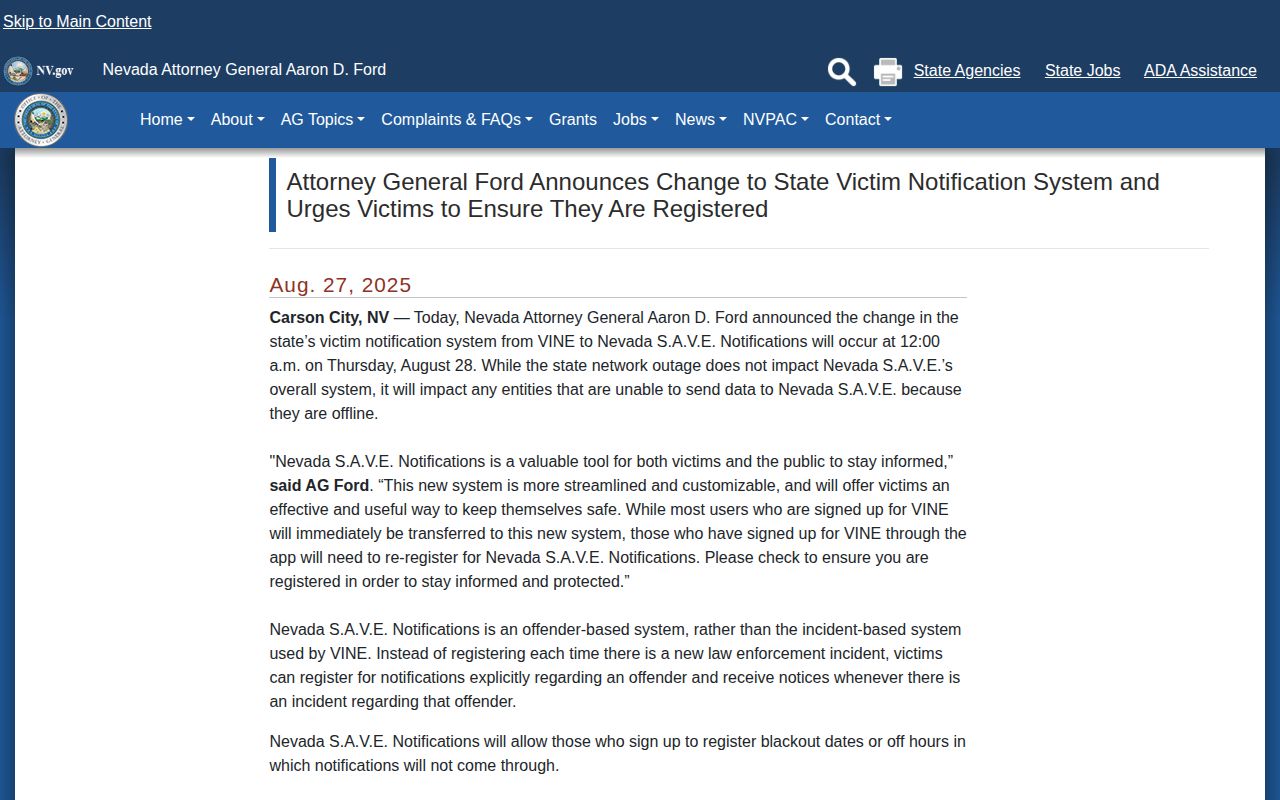
The notice explains why old VINELink directions should not be used as a current Eureka County inmate-check workflow.
Historical Eureka County VINELink
Before the cutoff, Nevada VINE allowed a search by name or offender number. A telephone registrant selected a four-digit PIN, while email registration did not require one. During an automated call, the user entered that PIN followed by the pound sign to acknowledge the message and stop repeat calls. Unanswered calls could be retried for up to 48 hours. Release, transfer, escape, and death were among the event types described in the retired materials.
Those facts explain old brochures and saved instructions. They are not a working 2026 registration path. Calling the old VINE number, using the old PIN routine, or searching a historic VINELink page should not be presented as Nevada’s current service. Begin at S.A.V.E. and use its live prompts.
- Notification
- An automated notice that an agency reported a custody event.
- Transfer
- Movement to another agency or facility, not release to the community.
- Discharge
- An official end to the relevant custody or supervision status, shown by the responsible agency’s record.
Eureka County No-Result Checks
A S.A.V.E. no-result does not prove release. The portal may omit people who are no longer in custody, and the identifying details may not match the stored record. First contact the Eureka County Sheriff at 775-237-5330 and ask which facility currently or most recently held the person. If White Pine or Lander processed the exit, request that jail’s custody and release entry. Compare the answer with the relevant Eureka Justice Court or Seventh Judicial District Court order.
Use NDOC’s offender search for a person sentenced to Nevada state prison. A profile marked “PAROLE” reflects supervised release, not the end of the sentence, while the downloadable Release data can identify a release date and description tied to an offender and booking episode. For a person held only in a county jail, an NDOC no-result proves nothing. The broader named-person path is covered on the Eureka County released-inmate search.
Court records add another check. Eureka Justice Court handles misdemeanor outcomes and the early stages of felony or gross-misdemeanor cases. After bind-over, the Seventh Judicial District Court clerk maintains the felony or gross-misdemeanor disposition. Ask for the docket and the order that addressed bail, dismissal, time served, probation, or prison commitment. The order can explain why custody should change, though the housing jail’s log is still needed to prove when the person left that facility.
A written request is useful when a call resolves only the location. ECSO Records requires its completed form and accepts requests by email, mail, or in person. Ask for the custody movement and release log, including the release date and time, description or code, and destination. If ECSO did not process the exit, ask it to identify the correct custodian. Nevada’s fifth-business-day response framework requires a response, denial with authority, custodian statement, or written estimate. It does not promise final production within five days.
Eureka County Custody Boundaries
Each custody system answers a different question. S.A.V.E. sends notices from participating Nevada agencies. ECSO identifies the actual local or contract housing jail. NDOC covers Nevada state-prison custody and release data. The BOP locator covers federal prisoners, while ICE’s locator is aimed at current immigration detention. The U.S. Marshals Service has no public historic release locator like BOP.
| Person or event | Best confirmation |
|---|---|
| Eureka or contract-jail release | ECSO routing plus the housing jail’s release record |
| Nevada prison release | NDOC Release data or an Offender Management Division record |
| Parole status | NDOC profile, then Nevada Parole and Probation confirmation |
| Federal release | BOP locator or federal court and custodian records |
| S.A.V.E. alert | The agency named in the notice |
For a projected prison date rather than a custody alert, use the Eureka County Release Date Lookup. A projected milestone can change and is not the same as a reported physical exit.
Registry information is also narrow. Nevada’s public sex-offender registry covers only people and fields made public under its governing law. It is not a list of all released inmates, and a registry entry does not prove the date a jail or prison processed release. Local news and app bulletins can supply context, but neither is a full custody archive. An agency record outranks those indirect clues.